‘I’m Chevy Chase and You’re Not’ Review: Reassessing SNL’s Original Superstar
This documentary explores how talent, timing, and temperament gave shape to one of the most conflicted legacies in American comedy.

In the long line of comedians who became famous on Saturday Night Live and then successfully crossed over into movie stardom, there is something like a black hole right at the center. It belongs to the very first—and initially most successful—former cast member to make that leap, and yet one who is rarely remembered, celebrated, or honored. In fact, although he was invited to and attended the televised 50th anniversary of SNL, he did not appear in a single sketch. The owner of this uneasy legacy is none other than Chevy Chase, widely regarded as the breakout star of the show’s original cast and a man who, after a decade as a Hollywood superstar, slowly faded from the map. This documentary sets out, in its own way, to solve that mystery.
Some context first. Chase was so central to SNL in its early years that many people considered it his show, with the rest of the cast functioning as supporting players. He was young, physically gifted (falls, pratfalls, slapstick), and projected an arrogance that—at least initially—came across as charming, self-parodic, and sarcastic rather than hostile. That comic persona was cemented through Weekend Update, the mock-news segment he originated and defined, and whose basic format and tone, with variations, survives to this day.
The problem is that Chevy started believing the hype. Convinced he was bigger than the show, and encouraged by his agent (at least according to this film), he left SNL to pursue a career as a Hollywood leading man. In doing so, he became the first to build the bridge that dozens would later cross—Eddie Murphy, John Belushi, Dan Aykroyd, Bill Murray, Adam Sandler, Will Ferrell, and many others. Professionally, the gamble paid off at first. Chase starred in several of the biggest comedy hits of the following decade, including Foul Play (1978), Caddyshack (1980), Fletch (1985), Three Amigos! (1986), and the National Lampoon films: Vacation (1983), European Vacation (1985), and Christmas Vacation (1989). But then his career hit a wall, collapsed, and never truly recovered. And it wasn’t just a matter of bad professional choices. There was—and still is—something else going on.
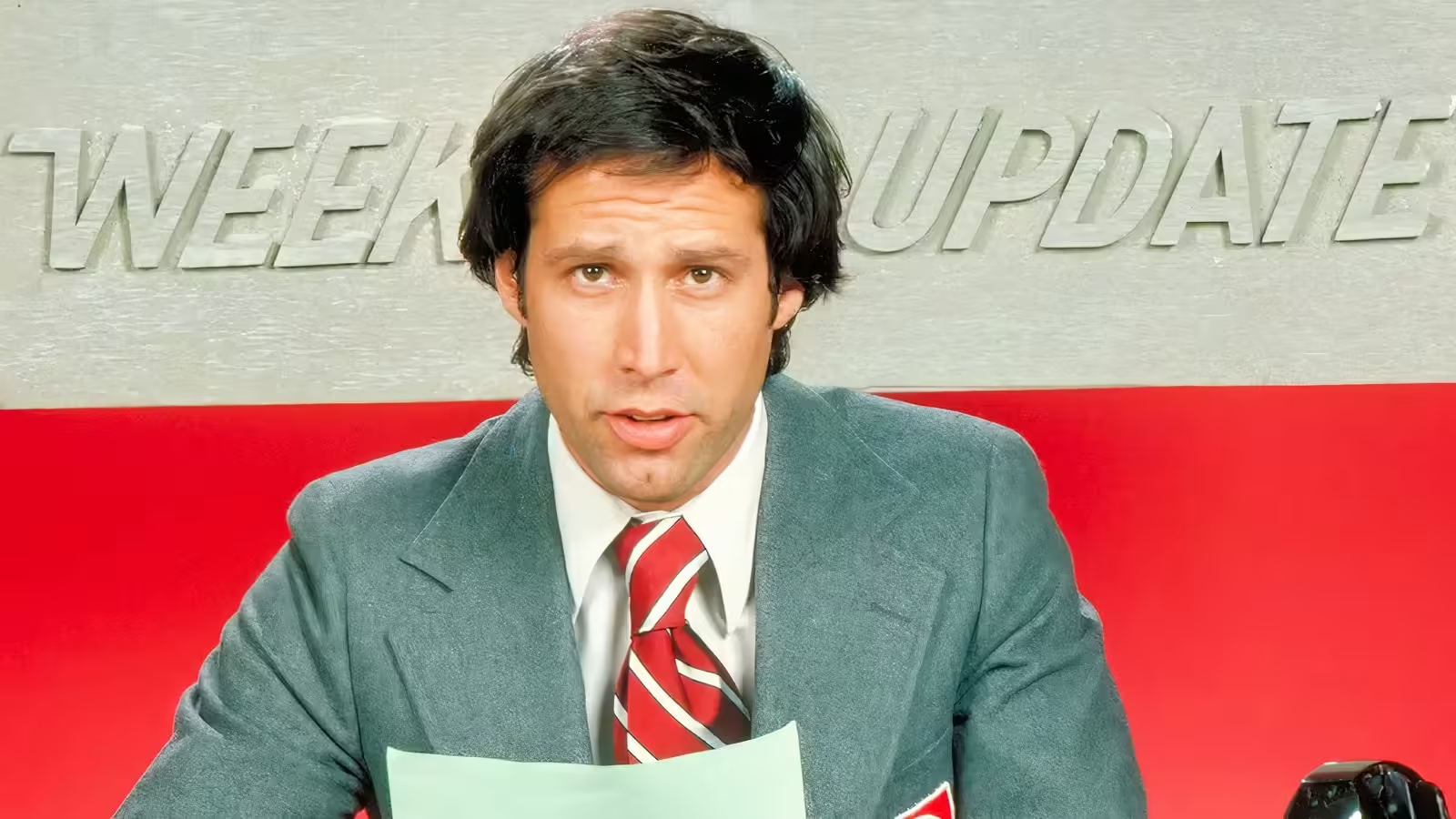
“I’m Chevy Chase… and you’re not” was how he introduced himself at the start of every Weekend Update segment. The documentary’s title echoes that line, and the choice—arrogant-sounding out of context—is very much intentional. Perhaps Chase’s biggest problem, striking in an industry overflowing with large and difficult personalities, is that he became infamous for his outsized ego, his mistreatment of fellow performers, and a way of dealing with colleagues that veered between cynical, sarcastic, and outright cruel. That reputation has effectively turned him into a pariah within the comedy world and within the internal mythology of SNL itself—so much so that he was sidelined during the show’s most important historical celebration. This documentary not only revisits key moments of his career, but also confronts that reputation and its consequences.
In interviews conducted by Marina Zenovich (director of Roman Polanski: Wanted and Desired), Chase never quite abandons the acidic humor that defines him. But given his history, that tone is no longer read as wit—it registers as pure arrogance. Chase himself, along with his closest friends and family, understands that this trait has repeatedly gotten him into trouble. Without fully unpacking their explanations or justifications, it’s clear they see it as a coping mechanism for deeper personal struggles. The issue, of course, is that very few people are willing—or able—to distinguish between “joking” mistreatment and behavior that spills over into real life.
His wife, daughters, relatives, colleagues, and admirers—including Goldie Hawn, Ryan Reynolds, Beverly D’Angelo, Martin Short, Lorne Michaels, Dan Aykroyd, musician Paul Shaffer, and super-agent Mike Ovitz—attempt to explain Chase’s complicated legacy, his choices, his successes and failures. They describe their fascination with—and even affection for—a man who has clearly not made many friends along the way. Notably, very few SNL alumni appear here to speak positively about him, and no one from the cast of Community—his one significant late-career success—shows up at all. That absence is telling, given how badly he exited that show and how few bridges were left intact. Even at 82, frail and reflective, Chase finds himself with remarkably few public defenders.
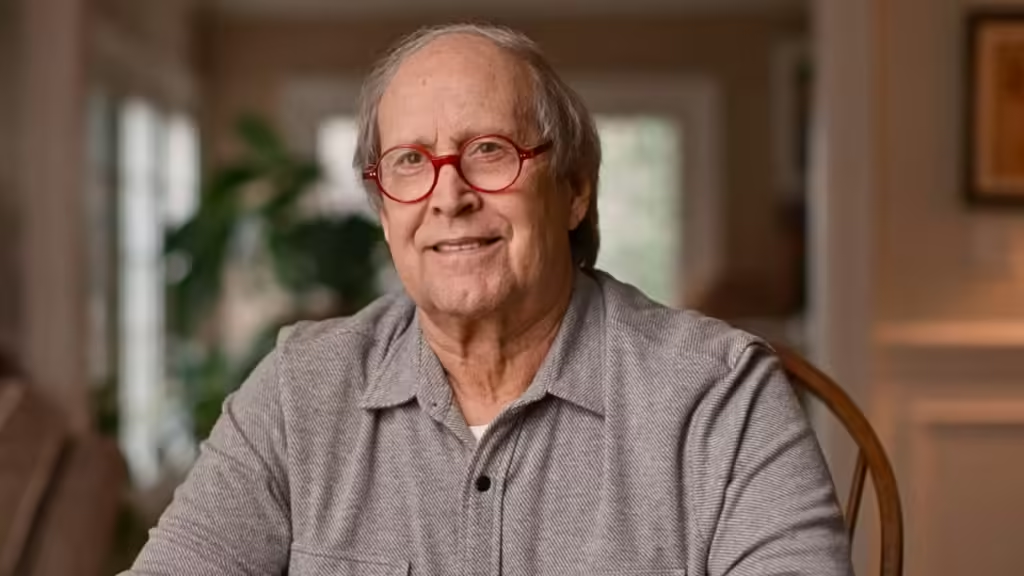
Zenovich occasionally stages mild confrontations with Chase—some of which are repurposed as promotional clips—but the film is, above all, celebratory: a carefully shaped product designed to soften his image and secure a kinder version of his legacy. We see him warm with his family, generous with friends, and explaining or contextualizing past behavior through a history of family trauma and addiction. Chase openly acknowledges his difficult personality. He speaks bluntly, without filters, in a way that often lands as abrasive and which he delivers with a straight face. More than once, this has led him to make hurtful, racist, or insensitive remarks—comments he insists are sarcastic, but which others understandably take at face value. Those around him argue that his bad reputation has been exaggerated, that the press unfairly singled him out and turned him into a cartoon villain.
So what’s the truth? We’ll never fully know. I’m Chevy Chase and You’re Not doesn’t deny the darker side, but it does try to bring the other one into focus: the talent, the impeccable comic timing, and the complicated story behind the persona. At the same time, the lack of colleagues willing to participate in this tribute—and the very public snubbing he endured at SNL not long ago (an episode Chase and his family found deeply painful)—make it clear that those tensions are still unresolved, decades after his peak.
Don’t expect answers from a documentary like this. Its purpose is not to expose hidden truths. It offers a few secrets, draws us closer to its subject, invites us to peer into his contradictions—but it is ultimately calibrated toward empathy and brand management. In Hollywood, after all, truth is often a public-relations battle.